When Nature Becomes Architecture: The Flower That Built Itself
Exploring the mathematical precision and architectural genius hidden in a simple flower structure—and what it teaches us about design, both natural and human.
The Architect That Never Went to School
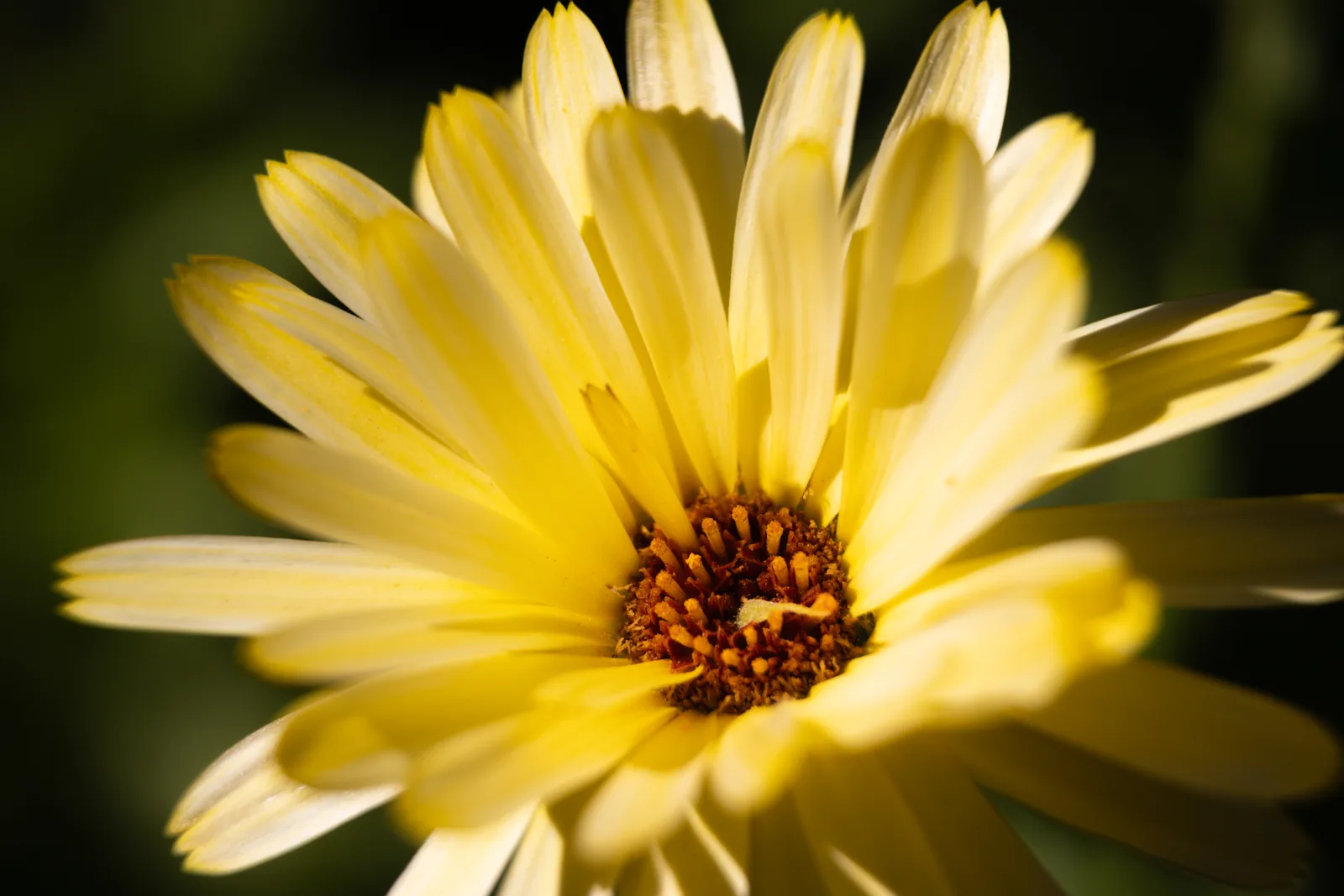
Look closely at this flower and you’ll see something remarkable: it’s not just growing—it’s built. Those petals aren’t randomly arranged; they follow mathematical principles that architects and engineers spend years studying. The structure exhibits radial symmetry, strategic reinforcement, and an ingenious balance between strength and delicacy.
Nature is the ultimate architect, and this flower is proof.
The Discovery
I found this bloom in a local garden during that golden hour when autumn light turns everything slightly amber. At first glance, it was just another flower—pretty, sure, but what caught my attention was the way light revealed its structure. The petals weren’t just overlapping; they were interlocking, each layer supporting the next in a precise geometric arrangement.
That’s when I stopped thinking of it as a flower and started seeing it as a sculpture. Or rather, as architecture. A masterpiece of natural engineering that put itself together without blueprints, without conscious design, following only the instructions encoded in its DNA.
The Mathematical Poetry
If you count the petal layers radiating from the center, you’ll likely find they follow patterns related to the Fibonacci sequence—those numbers where each is the sum of the previous two (1, 1, 2, 3, 5, 8, 13…). This sequence appears throughout nature in everything from nautilus shells to galaxy spirals, and yes, in flower petal arrangements.
Why? Because Fibonacci patterns provide optimal packing efficiency. Each petal positioned at approximately 137.5 degrees from the last (the “golden angle”) ensures maximum exposure to sunlight and pollinators while minimizing gaps and overlaps.
The flower doesn’t “know” this mathematics. It simply follows genetic instructions that evolution refined over millions of years, selecting for arrangements that worked best. The math is emergent—a consequence of successful design, not a conscious choice.
The Technical Challenge
Photographing this required treating it like architectural photography at a miniature scale. At f/6.3, I had enough depth of field to render multiple petal layers sharp—essential for revealing the structural complexity—while still maintaining that soft, out-of-focus background that prevents distraction.
The 103mm focal length provided the magnification I needed while keeping me far enough back to avoid disturbing the plant or casting shadows. This slight telephoto perspective also provided subtle compression that emphasized the layered quality of the petals.
At ISO 100, every detail is captured with maximum clarity—the subtle texture on each petal surface, the slight variations in color from base to tip, the delicate edges that catch light like fiber optics.
The 1/320s shutter speed froze any motion from breeze while remaining hand-holdable at this focal length. Any slower and I’d risk motion blur; any faster and I’d have needed to sacrifice ISO or aperture, compromising either detail or depth of field.
What the Light Reveals
The overcast sky provided the soft, even illumination that lets you see the structure without harsh shadows obscuring details. Direct sunlight would have created dramatic contrast—beautiful in its own way, but not what this subject needed. This flower’s story isn’t about drama; it’s about precision.
Look at how the light moves across the petals. Each layer catches slightly different illumination, creating subtle tonal variations that help your eye distinguish one level from another. Without this graduated lighting, the intricate structure would collapse into visual flatness.
The Color Story
The peachy-pink hue with hints of cream and the faintest touch of coral isn’t just aesthetically pleasing—it’s strategically designed to attract specific pollinators. Colors in the pink-to-purple spectrum are highly visible to bees, whose vision extends into ultraviolet ranges we can’t perceive.
What we see as a simple pink gradient might appear to a bee as a complex pattern with ultraviolet nectar guides pointing toward the flower’s center. The flower isn’t just beautiful to us; it’s a carefully designed landing beacon for its pollinators.
The Engineering Genius
Consider what this structure must accomplish:
Support its own weight while remaining flexible enough to bend in wind without breaking. The petals overlap in ways that distribute stress, preventing any single point from bearing too much load.
Protect the reproductive structures at the center while remaining accessible to pollinators. The layered petals create a protective cavity that shields vulnerable stamens and pistils from rain and damage.
Maximize surface area for pollinator visibility while minimizing material cost. Each petal is thin, lightweight, efficient—no excess bulk, just what’s needed for the job.
Maintain structure through multiple days of bloom despite having no rigid skeleton. The petals’ slight recurve creates inherent stability through geometric form rather than material strength.
All of this achieved through cellular growth following genetic templates refined over evolutionary time. No conscious design, no iterative prototyping, no design reviews—just the elegant efficiency of natural selection.
The Designer’s Lesson
As someone who designs software interfaces, I find myself constantly thinking about this flower when approaching design problems. Nature teaches several crucial lessons:
Efficiency is beautiful. The flower has no excess. Every petal serves multiple functions. Every curve has purpose. True elegance comes from doing exactly what’s needed and nothing more.
Structure enables flexibility. The flower’s geometric arrangement provides stability that allows individual petals to move independently. Good architecture creates freedom, not constraints.
Patterns scale infinitely. The same Fibonacci principles that organize these petals also organize galaxy spirals. Good design patterns work at every scale.
Form follows function, but beauty emerges. The flower’s beauty isn’t separate from its function—it IS its function. The most elegant human designs achieve the same synthesis.
Why This Resonates
I think people respond to images like this because they reveal order within what first appears organic and chaotic. There’s something deeply satisfying about discovering that nature follows principles, that apparent complexity emerges from simple rules applied consistently.
It’s the same satisfaction we get from understanding how code works, how systems fit together, how simple components combine to create sophisticated behaviors. Pattern recognition is deeply human—we’re wired to find order, to understand systems, to appreciate elegant solutions.
The Macro Meditation
Working at this magnification requires a particular kind of focus. You’re not just composing a scene; you’re selecting which specific petals to render sharp, which layers to prioritize, where to position the exact plane of focus for maximum structural clarity.
Every tiny adjustment of position—we’re talking millimeters—changes what’s sharp and what falls away. You become hyper-aware of depth, of dimensionality, of how three-dimensional structures collapse into two-dimensional images.
It’s a meditation on attention itself. At this scale, there’s no room for distraction. You’re fully present with your subject, collaborating with light and optics to reveal what the naked eye might miss.
For Aspiring Photographers
If you want to photograph flowers as architecture:
Look for structural complexity. Not all flowers make good architectural subjects. Look for layered petals, geometric arrangements, clear patterns.
Use depth of field strategically. You want enough sharpness to reveal structure, but not so much that busy backgrounds compete for attention.
Shoot in even light. Overcast days are your friend. Soft light reveals gradual depth and subtle texture that harsh sun would obscure.
Consider your angle carefully. Shooting straight down often reveals radial symmetry best. Side angles emphasize layering and depth.
Focus on the third layer. Not the very front petals, not the center—somewhere in the middle. This often provides the best sense of three-dimensional structure.
Watch your background. Even out-of-focus backgrounds can enhance or detract. Position yourself so the background complements your subject.
The Philosophical Thread
There’s something humbling about photographing subjects like this. The flower has no awareness of its own beauty, no appreciation for its mathematical elegance, no pride in its architectural genius. It simply is, executing genetic instructions that result in this remarkable form.
Meanwhile, I spend 30 minutes adjusting camera settings, considering composition, waiting for ideal light—all this attention lavished on a subject that has no concept it’s being photographed, that will bloom and fade according to its own timeline regardless of my documentation.
Maybe that’s okay. Maybe even perfect. The flower doesn’t need my photographs. I need them—as reminders to slow down, to look closely, to appreciate the extraordinary engineering hiding in plain sight all around us.
What This Image Captures
Beyond the obvious beauty, this photograph preserves a specific moment in this flower’s brief existence. Flowers at peak bloom last only days—sometimes just hours. The exact arrangement of petals in this image, the precise way they caught that particular evening’s light, existed only once and will never be exactly replicated.
The flower has long since faded. But this moment of structural perfection, this brief window when all the petals had opened but none had yet begun to fall, remains frozen here.
Related Reading
If the intersection of nature, design, and mathematical beauty interests you, check out:
- Celebrating the Common: Marigolds - More macro photography revealing intricate flower structures and technique
- The Drama of Light and Shadow - Advanced technical approaches to making flowers cinematic
- Permanence and Its Opposite - Philosophical reflections on nature’s design and the passage of time
Prints Available
This photograph celebrates the intersection of natural beauty and mathematical precision. It works wonderfully in spaces dedicated to design, creativity, or simply appreciating the architectural genius that surrounds us everywhere in nature.
View in Gallery | Order a Print
The Final Parallel
In software development, we talk about “elegant code”—solutions that do exactly what’s needed with minimal complexity, where structure enables flexibility, where simple rules combine to create sophisticated behavior.
Nature has been writing elegant code for billions of years. Every flower is a perfect deployment. Every bloom is production-ready. Every petal is a feature that works exactly as intended.
Maybe the best way to become better designers—whether of software, buildings, or anything else—is to spend more time studying nature’s architecture. Not to copy it directly, but to understand the principles that make it work: efficiency, purpose, pattern, and the emergence of beauty from functional necessity.
The flower doesn’t try to be beautiful. It tries to be effective. Beauty is what happens when effectiveness is perfected.
That might be the most valuable design lesson of all.
What examples of natural architecture have influenced your design thinking? I’d love to hear about the nature-inspired solutions you’ve encountered or created. Share your observations below—great design deserves to be noticed.